
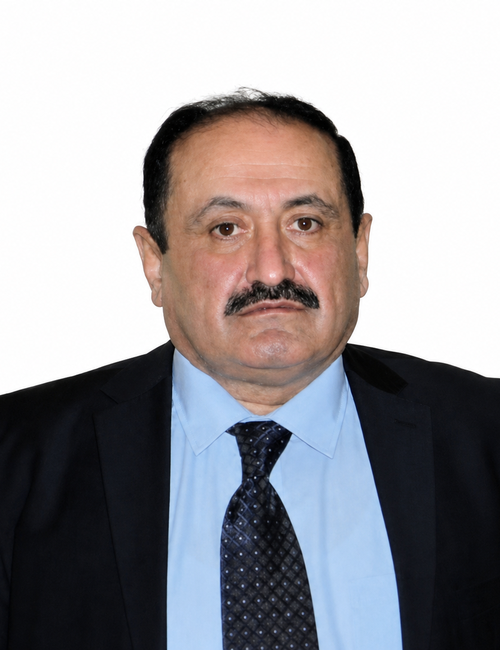
Academic Staff

June 8, 2026, 1:18 a.m.
Ramadhan Abed Mohammed (PhD) Dean of College of Basic Education
None
Professor in General Topology

Mathematics
College of Basic Education
University of Duhok

  • PhD of Topology, College of Science, University of Duhok, University of Assiut, Egypt, 2018.
  • MSc of Topology, College of Education, University of Duhok, 2005.
  • BSc in Mathematics, College of Science, University of Mosul, 1990.

My academic career began at the University of Duhok in 2005, where I was assigned to teach in the Colleges of Education and Basic Education. My initial phase focused on providing undergraduate students in the Physics, Computer Science, and Mathematics departments with fundamental concepts through general mathematics courses.

My teaching experience expanded to include a wide range of advanced specialized courses, most notably calculus, cross-sectional mathematics, and topology, in addition to courses in mathematical analysis and differential equations. This diversity contributed to developing in-depth expertise in presenting abstract mathematical concepts, with a focus on building students' analytical skills and deep understanding.

My career has been characterized by continuity and a commitment to developing teaching practices and designing effective curricula, aiming to simplify complex ideas and encourage critical thinking. The educational vision aims to elevate the quality of university education and prepare graduates capable of utilizing mathematical knowledge as a fundamental tool in their scientific and applied fields—a journey that continues to this day.

Academic Leadership


My academic and administrative career represents a model of integration between scholarly work and university service. This journey began with obtaining a Master's degree from the University of Duhok – College of Education in 2005, after which I continued to develop my scientific and administrative expertise by taking on numerous academic and leadership responsibilities within the university.
In the administrative field, I served as the Director of Registration at the College of Education from 2006 until 2007, contributing during this phase to the organization of academic and administrative processes related to student affairs. Subsequently, I held the position of Vice Dean of the College of Science from 2007 to 2014, where I participated in managing the college's academic and administrative affairs and supporting its institutional development.
I also played an active role in ensuring the quality of the educational process by chairing examination committees at the College of Science and the College of Basic Education for over ten years, which contributed to enhancing academic integrity and improving evaluation and examination mechanisms. Additionally, I chaired the Procurement and Bidding Committee at the College of Science for several terms, participating in resource management according to approved legal and administrative principles.
In the context of academic leadership, I was appointed Head of the Mathematics Department at the College of Basic Education on 2016, and continued in this position until 2022, where I worked on developing curricula and elevating the department's scientific performance. During this stage, I successfully completed my doctoral studies in 2018, which bolstered my research and academic expertise and contributed to expanding my scientific contributions.
From 2022 to the present, I have been serving as the Dean of the College of Basic Education, in addition to holding the position of Acting Dean of the College of Education. In these roles, I lead academic and administrative plans, enhance the quality of higher education, and support scientific research and community service.
These accumulated experiences, spanning many years of academic and administrative work, reflect a steadfast commitment to developing higher education institutions, contributing to the preparation of scientific talent, and consolidating standards of quality and excellence within the university environment. If this article is intended for academic promotion or an official university profile, I can rephrase it in a more formal and academic style, highlighting leadership and research achievements more prominently.

Conference Participation and Academic Engagement

Throughout my academic career, I have actively participated in several national and international conferences, reflecting my commitment to advancing research in mathematics and fostering scholarly collaboration across disciplines.

In 2016, I participated in the One-Day Conference for Applied Mathematics at Assiut University, Egypt, where current developments and applications of mathematical sciences were presented and discussed. This event provided a valuable opportunity to exchange ideas with researchers and academics from various institutions.

In 2017, I took part in the 2nd International Scientific Conference on Engineering Sciences at the University of Duhok, Iraq, contributing to interdisciplinary scientific discussions and strengthening academic networks across research communities.

My engagement continued in 2018 through participation in the International Conference on Advanced Science and Engineering (ICOASE 2018), an internationally recognized forum that brought together researchers working on advanced topics in science and engineering. During the same year, I attended the National Conference on Pure and Applied Mathematics and Mathematics Education held in Erbil, Kurdistan Region, Iraq, which addressed recent developments in mathematical research and mathematics education.

In 2019, I participated in the International Conference on Advanced Science and Engineering (ICOASE 2019), which was technically sponsored by IEEE. The conference provided an excellent platform for presenting research findings and building international academic connections.

These conferences have contributed to my professional development by keeping me informed of emerging trends in topology and related areas of pure mathematics, while also enabling meaningful collaboration and knowledge exchange with scholars from mathematics and other scientific disciplines.

Professional Development and International Training

Throughout my academic career, I have been committed to continuous professional development in teaching, leadership, administration, and language skills. To enhance my academic and administrative competencies, I have participated in several local and international training programs.

In 2012, I completed an eight-week methods of teaching course and participated in a Middle Leadership Development program organized by the University of Duhok in cooperation with the University of Kassel, Germany. In 2013, I attended a three-week training program at Michigan State University (USA) focusing on teaching methods and leadership development. In 2014, I successfully completed a 160-hour English language course at the University of Duhok. Also in 2014, I participated in a seven-day international training program on teaching methods at the University of Granada, Spain, and a partner university in Portugal.

These experiences enriched my pedagogical approach, leadership capabilities, and cross-cultural communication skills, and have directly informed my contributions to curriculum development, academic administration, and institutional advancement within the university.

Research

  1. Ameen, Z. A., Salih, H. F. M., Alajlan, A. I., Mohammed, R. A., & Asaad, B. A. (2025). Enhanced MCDM based on the TOPSIS technique and aggregation operators under the bipolar pqr-spherical fuzzy environment: An application in firm supplier selection. Applied Sciences, 15(7), 3597.
  2. Mohammed, R. A. (2025). Bipolar soft minimal structures. European Journal of Pure and Applied Mathematics, 18(2), 5928.
  3. Salman, S. M. H., Mohammed, S. A., & Mohammed, R. A. (2025). Analytic and numerical approaches for solving nonlinear Painleve' equations I and II. European Journal of Pure and Applied Mathematics, 18(3), 6215.
  4. Abdulkareem, H. D., Mohammed, R. A., & Ameen, Z. A. (2024). Connectedness of soft r-topological spaces. New Mathematics and Natural Computation, 20(1), 27–43.
  5. Ameen, Z. A., Mohammed, R. A., Al-shami, T. M., & Asaad, B. A. (2024). Novel fuzzy topologies formed by fuzzy primal frameworks. Journal of Intelligent & Fuzzy Systems, 48(1, Suppl.), 131–140.
  6. Saleh, H. Y., Asaad, B. A., & Mohammed, R. A. (2024). Novel classes of bipolar soft generalized topological structures: Compactness and homeomorphisms. Fuzzy Information and Engineering, 16(1), 49–73.
  7. Saleh, H. Y., Salih, A. A., Asaad, B. A., & Mohammed, R. A. (2024). Binary bipolar soft points and topology on binary bipolar soft sets with their symmetric properties. Symmetry, 16(1), 23.
  8. اقدل، رحمة احمد، عبد الله، عبد الرزاق ياسين، و رمضان عابد. (2024). فاعلية توظيف استراتيجيات العبء المعرفي في تحصيل طلبة قسم الرياضيات لمادة التبولوجي. مجلة التربية للعلوم الإنسانية، 4(13)، 321–350.
  9. حسن، فيان، عبد الله، عبد الرزاق ياسين، ومحمد، رمضان عابد. (2023). فاعلية برنامج تدريبي يستند على نظرية معالجة المعلومات لإكساب طلبة قسم الرياضيات مهارات الإتصال. مجلة التربية للعلوم الإنسانية، 3(12)، 39–70.
  10. Ameen, Z. A., Mohammed, R. A., Al-shami, T. M., & Asaad, B. A. (2023). Novel fuzzy topologies from old through fuzzy primals. arXiv preprint arXiv:2308.06637.
  11. Musa, S. Y., Mohammed, R. A., & Asaad, B. A. (2023). N-hypersoft sets: An innovative extension of hypersoft sets and their applications. Symmetry, 15(9), 1792.
  12. Afdel, A. R. A., Yassin, A. R., & Mohammed, R. A. (2022). The effectiveness of planning organizations in developing reflective thinking among mathematics department students. Journal of Basic Sciences, 7(11), 195–226.
  13. Hassan, M. V., Yassin, A. A. R., & Mohammed, R. A. (2022a). The effectiveness of a training program based on information processing theory for the students of the department of mathematics to obtain communication skills. Journal of Education for Humanities, 3(12), 39–70.
  14. Hassan, M. V., Yassin, A. A. R., & Mohammed, R. A. (2022b). The effectiveness of a training program based on information processing theory in developing mental motivation among mathematics department students. Journal of Basic Sciences, 7(11), 255–288.
  15. Mohammed, R. A., Rasheed, G. H., & Khalaf, A. B. (2022). Soft α-I-open sets and some of their properties. Journal of Mathematics and Computer Science, 28(3), 306–315.
  16. Saleh, H. Y., Asaad, B. A., & Mohammed, R. A. (2022a). Bipolar soft generalized topological structures and their application in decision making. European Journal of Pure and Applied Mathematics, 15(2), 646–671.
  17. Saleh, H. Y., Asaad, B. A., & Mohammed, R. A. (2022b). Bipolar soft limit points in bipolar soft generalized topological spaces. Mathematics and Statistics, 10(6), 1264–1274.
  18. Mahmoud, U. S., Albahri, A. S., AlSattar, H. A., Zaidan, A. A., Zaidan, B. B., Albahri, O. S., Alamoodi, A. H., Mohsin, A. H., & Al-Mashhadani, A. F. (2021, September 20). A methodology of DASs benchmarking to support industrial community characteristics in designing and implementing advanced driver assistance systems within vehicles [Preprint]. Research Square. https://doi.org/10.21203/rs.3.rs-875230/v1
  19. Mohammed, R. A., Vani, S. V., & Arasi, K. B. D. (2021). Contributions to the study of soft closedness in soft topological spaces. Journal of Xi’an Shiyou University, Natural Science Edition, 17(4), 136–142.
  20. Ameen, Z. A., Asaad, B. A., & Mohammed, R. A. (2019). On superclasses of δ-open sets in topological spaces. International Journal of Applied Mathematics, 32(2), 259–278.
  21. Mohammed, R. A., & Amen, R. S. (2019). Soft ξ-open sets in soft topological spaces. Science Journal of University of Zakho, 7(3), 108–119.
  22. Mohammed, R. A., & Sayed, O. R. (2019). Soft J s-spaces and strong soft J s-spaces. 2019 International Conference on Advanced Science and Engineering (ICOASE), 241–246.
  23. Mohammed, R. A., Sayed, O. R., & Eliow, A. (2019). Some properties of soft delta-topology. Academic Journal of Nawroz University, 8(4), 352–361.
  24. Muhammed, R. A. (2018). On soft topological spaces with some applications [Doctoral dissertation, University of Duhok].
  25. Mohammed, R. A. (2018). On soft separation axioms in fuzzifying soft topological spaces. 2018 International Conference on Advanced Science and Engineering (ICOASE), 341–346.
  26. Mohammed, R. A., Ismail, T. H., & Allam, A. A. (2018a). On fuzzifying soft topological spaces. International Journal of Pure and Applied Mathematics, 120(2), 149–170.
  27. Mohammed, R. A., Ismail, T. H., & Allam, A. A. (2018b). On soft semi-open sets and soft semi-continuity in fuzzifying soft topological spaces. Eurasian Journal of Science and Engineering, 4(2), 158–177.
  28. Allam, A., Ismail, T. H., & Muhammed, R. (2017). A new approach to soft belonging. Annals of Fuzzy Mathematics and Informatics, 13(1), 145–152.
  29. Ibrahim, B. S., Mohammed, S. H., Mohammed, R. A., Hassan, M. H., & Helmy, Z. M. (2017a). Effect of inspiratory muscle training on cardiac parameters of exercise tolerance test in chronic heart failure patients. The Egyptian Society of Industrial Medicine.
  30. Ibrahim, B. S., Mohammed, S. H., Mohammed, R. A., Hassan, M. H., & Helmy, Z. M. (2017b). Ventilatory changes after inspiratory muscle training in chronic heart failure patients. The Egyptian Society of Industrial Medicine.
  31. Mohammed, R. A., Ismail, T. H., & Allam, A. A. (2017). A comment on generalized αb-closed sets. Journal of the Egyptian Mathematical Society, 25(1), 57–58.
  32. Mohammed, R. A., Salih, A. M., Mirza, M. A., Ismail, T. H., & Allam, A. A. (2017). Prognosis of liver disorders in DNA positive HBV patients based on fuzzy soft sets. Science Journal of University of Zakho, 5(1), 112–119.
  33. Mohammed, R. A., Ismail, T. H., & Allam, A. A. (2016). On soft gαb-continuous functions in soft topological spaces. Assiut Univ. J. of Mathematics and Computer Science, 44(2), 13–29.
  34. Mohammed, R. A., Ismail, T. H., Allam, A. A., & Abd Elbaset, M. A. (2016). Prognosis of coronary artery disease depending on soft sets. Andamios, 12(27), 153–159.
  35. Mohammed, R. A., Ismail, T. H., & Allam, A. A. (2015). On soft generalized αb-closed sets in soft topological spaces. General Mathematics Notes, 30(2), 54–73.
  36. Ibrahim, H. Z., & Mohammed, R. A. (2013). Some properties of Pγ-open sets. International Journal of Pure and Applied Sciences and Technology, 14(1), 53–61.
  37. Mohammed, R. A. (2012). Weakly sc-continuous functions. Journal of University of Duhok, 15(2), 51–59.
  38. Ameen, Z. A., & Mohammed, R. A. (2011). Some new separation axioms. Journal of University of Duhok, 14(1), 1–6 (Reprinted in Special Issue: Territorial Planning and the Local Development, 156–159).

My research interests span topology, applied mathematics, mathematics teaching methods, and decision-making. In topology, I am drawn to the study of abstract structures and the properties that remain unchanged under continuous transformations. This theoretical foundation supports my interest in applied mathematics, where I focus on using mathematical models and analytic tools to understand real-world systems.

Alongside these areas, I am committed to improving mathematics education. I explore teaching methods that help learners grasp complex ideas more effectively and develop stronger problem-solving skills. My interest in decision-making connects mathematics with human reasoning, using mathematical frameworks to guide choices under uncertainty.

Together, these fields reflect my broader goal: to bridge theory and practice in ways that deepen mathematical understanding and enhance its usefulness in education and real-world problem-solving.

My involvement in academic supervision dates back to 2005, when I began overseeing undergraduate projects in general mathematics. This experience has continued to the present day. Over the years, I have guided students in selecting appropriate research topics, developing their mathematical analysis skills, and formulating their findings in a rigorous scientific manner. This has had a clear impact on raising the quality of their graduation projects and enhancing their research capabilities.

Starting in 2018, my supervision expanded to include master's students, particularly in the fields of topology and mathematics teaching methodologies. At this level, I focused on deepening students' theoretical understanding and supporting their ability to apply advanced concepts to address original research problems. I also worked to help students adopt precise scientific methodologies and adhere to rigorous academic research standards, which contributed to the production of theses of high scientific and methodological value.

Throughout this extended career, academic supervision has been an integral part of my work. It has allowed me to contribute to developing the skills of emerging researchers and building a supportive learning environment that helps raise the academic level of students at all stages of their studies.